Window Deduplication

Description
The Window Deduplication node (window-deduplication) splits the stream into fixed (tumbling) windows of event time and emits, for every window and every key, the record with the earliest record_time. The other records of that key in that window are dropped.
It differs from Deduplication: that node keeps one entry per key with an inactivity timeout that resets on every event, while this node works in fixed windows aligned to the clock (a one-hour window covers 10:00-11:00, 11:00-12:00, ...), and emits the kept record when the window closes, i.e. when the watermark passes its end.
Under the hood the node runs a Flink SQL window deduplication query over the incoming records.
- The input of the node is one record variable available before the node (by default
#input) - all its fields, or a selected subset, become the fields of the output, plusrecord_time,window_startandwindow_end. - The node clears all upstream variables - after the node only the output variable is available.
The node is available only in the Streaming processing mode, for unbounded streams.
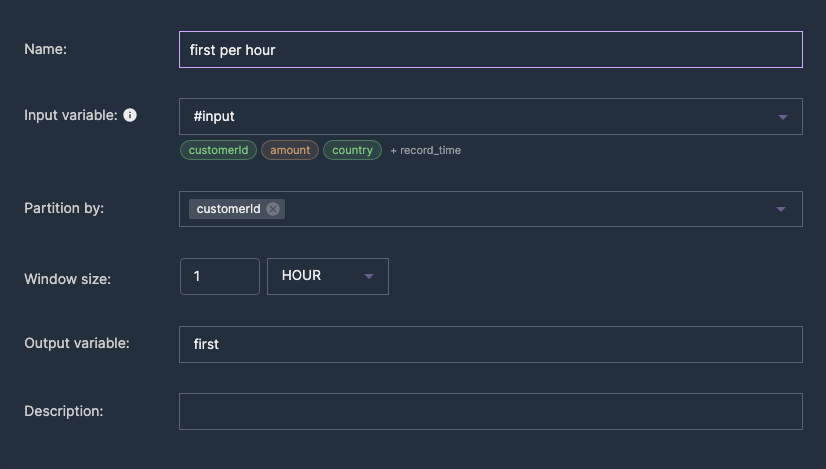
Parameters and configuration
| Name | Description |
|---|---|
| Input | The record variable and the fields to keep in the output. |
| Partition by | The fields making up the key; records with the same values of all of them are deduplicated together. With no fields, one record per window is kept. |
| Window size | The length of the window, e.g. 1 HOUR. |
| Output variable name | The name of the variable holding the kept record. |
Additional considerations
- The node is stateful: open windows live in Flink state and are restored from a savepoint when the scenario is redeployed. Changing the key or the window size may make the state incompatible.
- Records are emitted when the window closes, not when they arrive. Late records (behind the watermark) are dropped.
- The node can't be mocked in scenario tests - it has to be fed real records.